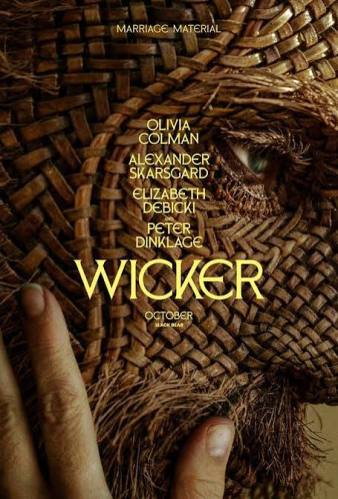
“It’s easier to believe the bad than the good.”
Story: A small village has people with small minds. But the local fisherwoman likes to keep out of village life and gossip, prefering to keep to herself. Though when a wedding has the village pointing to her as the next to marry, she decides to take matters into her own hands. Okay fine; she goes to the basket maker to put it into his hand. Yeah, he weaves her a husband so hot he’s probably a danger to is woven self.
Genre I’d put it in: Fantastically Fun Folklore
Release Date: 2026
Remake, Sequel, Based-On, or Original: Based on the short story “The Wicker Husband”, by Ursula Wills.
Animals okay?: She’s a fisherwoman, so lots of fish cease to be.
Special Shout-out: Richard E. Grant’s hilariously deadpan turn as the Doctor, whose medical skills – and extreme lack of consideration – will have anybody who’s ever gone to the doctor shudder in horror.
Gotta say: I love me a paranormal romance. Things that howl, shuffle, bite and fly immediately catch my attention over on Kindle Unlimited (oh excuse me. Kindle+.) So when the trailers for Wicker started hitting the scene, I’ll admit I was intrigued. The premise sounded kind of silly, but then I saw the cast. With talents like Olivia Colman and Alexander Skarsgård as the happy couple, I knew this was going to be more than a bit of fluff. And damn if it isn’t a perfect skewering of patriarchal, misogynistic garbage. Well done.
The writing/directing team of Alex Huston Fischer and Eleanor Wilson balance each other well, delivering a story that is scandalous and touching, playful and thought-provoking. I’ll even admit to tearing up a time or two. Yes, I teared up at a love story between an outcast and a walking basket. The folks in front of and behind the camera more than delivered a story worth emotional investment.
There’s no patriarchy in the crafting of a basket (she said hopefully). So Wicker Husband simply treats everybody with kindness and generosity. Naturally, the stuck-in-the-mud villagers don’t understand, which quickly turns to mistrust and jealousy. Or, as my Grossie would say? “Was der Bauer nicht kennt, das frisst er nicht” (What the farmer doesn’t know, he doesn’t eat/like.) Skarsgård’s Wicker continues to be open and honest with everyone, no matter whether they deserve it or not. This quickly devolves into an Othello-esque subplot between Fisherwoman and the village’s Queen Bee, Tailor’s Wife, who has her own reasons for disliking the pair, and how the couple has upended the village. Elizabeth Debicki’s performance is steel-rod-backed, her Tailor’s Wife using backhanded niceties and her social standing to keep the village in line. This leads to a climactic confrontation between the two women and a slyly powerful final act.
As the Basket Weaver, Peter Dinklage’s soliloquies are Shakespearean. The Weaver is much like the Fisherwoman; a person ostracised from the community for not fitting in. (It’s intimated that his extensive travels before settling down in the community cast him in a suspicious light.) And damn those threads of his are amazing. From his cheeky hats to his dapper spats, Weaver is the kind of person you’d love to sit down next to at a pub. Unless you’ve been raised to eschew anything even vaguely interesting for the comfort of, well, fitting into the dull society you’re used to.
Fischer and Wilson’s story could have been a heavy-handed treatise on being a good neighbor, or rebuking worn-out rules that no longer serve any purpose. Instead, they let their characters show us the message by the way they act, interact, and deal with their surroundings. This is a village where marriage literally puts a collar around a woman’s neck, and the women celebrate it. When Wicker asks if a man actually loves his wife, there’s a shocked response from the other men; they’d never considered that before. Tailor’s Wife longs for a life where she contributes more than dinner and children, but nobody takes her seriously. And several of the men wear their disgusting contempt for women proudly. Everybody seems to be tryng to convince themselves they’re happy, even through their obvious disenchantment. Meanwhile Wicker is unashamed of his love, and of his relationship with his wife.
Then there’s the absolutely gorgeous cinematography and art direction. Shots so gorgeous they could be paintings you’d proudly hang. Village life, a quiet stream, the love between two individuals, all look so ourtrageously beautiful. Hell, even a scene where a man’s wounds are sewn up gives Renaissance vibes. The practical and CGI FX of Skarsgård’s Wicker is seamlessly perfect, with scenes of him holding up his hand and having the light pass through it. Touches like this help keep this fairy tale feeling real enough to step into.
This is the kind of film that could make viewers consider their lives, and how they interact with the world. What they want out of life, and if that’s good, bad, or simply not what they’d ever wanted. Let’s hope we all take the time to consider what Wicker has to say.
#Protip: There’s no post-credits scene for this one. Though like me, you may become entranced by the gorgeous end credits song. Thank composer Anna Meredith for this dreamlike ode to love. Hopefully we’ll hear it performed during the Academy Awards presentation early next year.





